The delicate balance between delusion and complicity [prompted by You Can See Everything]
This post has spoilers from "You Can See Everything" interspersed with my own societal analyses. Read on only if you've seen the movie or don't care about seeing it.
In my eyes, "You Can See Everything" is a documentary first and foremost about truth. The truth is not necessarily as instructive as people might like, because the more you know, the more questions you have. There are many truths, and with discernment you can establish their relevance, and I think this is where people get confused. A truth only matters when a fact questions it. Holmes's personal truth does not affect her culpability. I don't think there's as much uncertainty in the movie once you reconcile with reality. This reconciliation though is multi-faceted, and I think it starts with intent.
better things are possible, even if improbable
We all dream of a better life. We may not always agree on what is better, but any desires for improvement imply that we believe better things are possible. I think that people generally want what's best, even when they're wrong about what exactly that is. This applies for most things, professionally, politically, personally, and interpersonally.
Every inventor, record-breaker, and revolutionary usually has some understanding from the onset that the majority of attempts fail. Life demonstrates that it's almost delusional to believe that you can change it. The smaller the odds of success are, the more near-delusion you need to counteract it. With every dream, we emotionally counterbalance that chance.
The American Dream may not exist for most, but American innovation is proof that it's real. Founders and inventors come to the US not just for the capital, but for the delusion that fuels progress to levels not seen anywhere else in the world. Holmes is one of many who dared to dream[1]. Unfortunately, bravery does not realize dreams or make them any less fantastical. That's a separate question.
when delusion becomes complicity
Many an ambitious target will make founders count their chickens before they hatch. I want to emphasize that Holmes is probably in the majority in terms of founders exaggerating or overstating their product's capacity. In a way, I would argue that corporate America essentially expects that at this point. Shareholders want emotional comfort with big projections, and financial comfort with decent actual returns. If a promised product leads to a 30% increase in a company's valuation, but only delivers 80% of that promise, they're still likely to be in a better position than they were before. A better future is still realized.
We see Nathan ask multiple times in different ways whether Holmes knew her product didn't work. It's almost a break from reality as we realize Holmes doesn't see it this way. I see a number of posts questioning how manipulative she is or isn't, but I won't speculate on that because I think that's boring. Lying is obviously wrong, and I think the more interesting case is one where she truly believed what she was saying. The point where delusion becomes harm is far more important here.
There's a scene[2] re-enacted by Amanda Seyfried in The Dropout which Fielder says definitively and unfairly indicts Holmes with no room for error. Seyfried claims it's artistic license, and that there's no evidence to the dialogue either way. Reenactments and dramatizations aside, the only question that matters is whether the samples were actually thrown out. If Holmes's dream could only be realized by throwing out contradicting evidence, that's where complicity begins.
the question of agency in her complicity
In life and in love it seems Holmes is surrounded by terrible men. Holmes's dad[3] in the movie (and Holmes herself in her trial) allege that a sexual assault at Stanford led her to drop out and devote her life to Theranos. The phrase "(wo)men would rather do ______ than go to therapy" comes to mind here. Silicon Valley was bound to involve technofascists in her endeavors, and she only accelerated its influence via whom she chose to date. We see her defined by two key relationships: Sunny and Billy. Sunny started dating Holmes when she was 18 to his 37, over double her age.
A young genius is still young. I will never claim that a teenager has the capacity to understand the long-term effects of what they're doing. Due to that and the power differential financially, professionally, and personally, I do think that Sunny bears more responsibility in the establishment of Theranos than Holmes. As the company matured though, so did Holmes. At some point between 19 and 29, she understood what she was doing, and when she became the face of Theranos, she implied that she knew the mind of Theranos. Her agency is not in question by the time she becomes the face of her company.
In the same way, I refuse to deny her agency in her relationship with Billy. Billy is definitely a powerhouse[4] and forceful. I have seen no indication that Holmes has any issue with these traits. Maybe it can be argued that she hasn't seen that side of him, but that raises two questions:
- Do we think she's blind?
- Can ignorance save her?
ignorance vs. culpability
To put it bluntly, if a claim to innocence can be brought based on ignorance, then all you need is henchmen to do your dirty work. Committing a crime in Holmes's name doesn't necessarily condemn her, but her support of said crime would. In the least culpable scenario, Holmes is ignorant of the practices at her company and the use of her face and social media accounts by her husband. She is surrounded by conniving people and is merely caught in the crossfire of their malfeasance.
Putting aside how unbelievable that is, at what point would she take responsibility? If Theranos had worked and her husband was a saint, she would get the credit for the work conducted under her brand. Brand licensing still requires quality control from the brand owner because of the understanding that the brand is the brand. Naked licensing is akin to deceiving the public, and that is the bulk of her accusations.
Honestly, this situation seems pretty straightforward to me. I don't think Elizabeth Holmes is a bad person—or at least, I don't have enough evidence to say one way or another. What I do know is that people were deceived by Holmes's company, Theranos, and she had a large part in that. I think people want to live in a world where only clearly bad people commit crimes, but that's not how the real world works. She can contain multitudes. Martha Stewart is our grandmother and also broke the law.
shades of gray
Hopefully it's clear why even in the least culpable scenario, Holmes is still not innocent. It's far more likely that she knew and did more than the main scenarios I've outlined, in which case she's definitely guilty. Obviously, she is more than her charges. Backstories humanize their subjects, and humans can be complex. Nevertheless, in the realm of doing good vs. doing no harm, she did neither.
I said earlier that I wouldn't speculate on the manipulative piece, but I would be remiss of me to not mention that Holmes decided to have two children coincidentally before her trial and before her sentencing. The woman either has the world's worst timing, or is willing to go the distance. If her early release is any indication, her efforts were not in vain. Go big, sometimes make it home.
responses to other takes
double deviance theory
The double deviance theory states that women are treated more harshly in criminal court because they have deviated from both societal norms (crime) and gender norms (women not being criminals.) Every decision in life has a cost associated, and while we can argue whether a man would be paying the same price, that doesn't mean the price isn't fair. Women are often more scrutinized than men, but I often think that men should be scrutinized more, not that women should be scrutinized less. I have many issues with girlboss feminism but more so from the perspective that men (or rather, male-coded behaviors) are the problem. I would and do find men who act the same way as she did problematic, from their decisions to the way they carry themselves. This is why people in tech suck.
The critiques of the film/society ignoring her likely neurodivergence and sexual assault history also go here in the sense that they are not relevant to the deeds she is accused of. Autistic people are more than capable of crimes, and whatever differences they have in understanding the context of the crimes doesn't absolve them of their responsibility. We don't give sociopathic criminals a pass because they don't empathize with their victims. Victims are also more than their trauma and possess agency.
Response to Liz Plank: Elizabeth Holmes is literally just a man
the public spectacle of female humiliation
Far be it from me to deny the existence of the weird pleasure many people seem to take in Holmes's downfall, but I don't think this film is it. Having watched none of Fielder's other work, I don't see this as him taking advantage of her. His sense of humor and framing is pretty apparent throughout the first half of the film, but I do think the second half appropriately questions even that reality. Once that wall is broken, I think the responsibility is on the audience to disregard their assumptions.
The accusations of making a spectacle of Holmes are secondary to the fact that
- She did quite literally ask for this
- There are few liberties taken in Holmes's depiction, and the ones that are, are questioned in real time
Elizabeth Holmes is a spectacle. Her achievements, conduct, looks, and claims have garnered acclaim for decades at this point, and that is what she needed in order to do what she wanted[5]. Regardless of her intentions, she is a public figure and chose to be so in order to further her goals. To deny her culpability in her image is to deny her agency. We may not be able to see everything, but we've definitely seen enough.[6] 10/10 movie.
Sort of a response to Sam Bodrojan: “You Can See Everything” Is A Film About Feminism and various comments/tweets I stumbled upon.
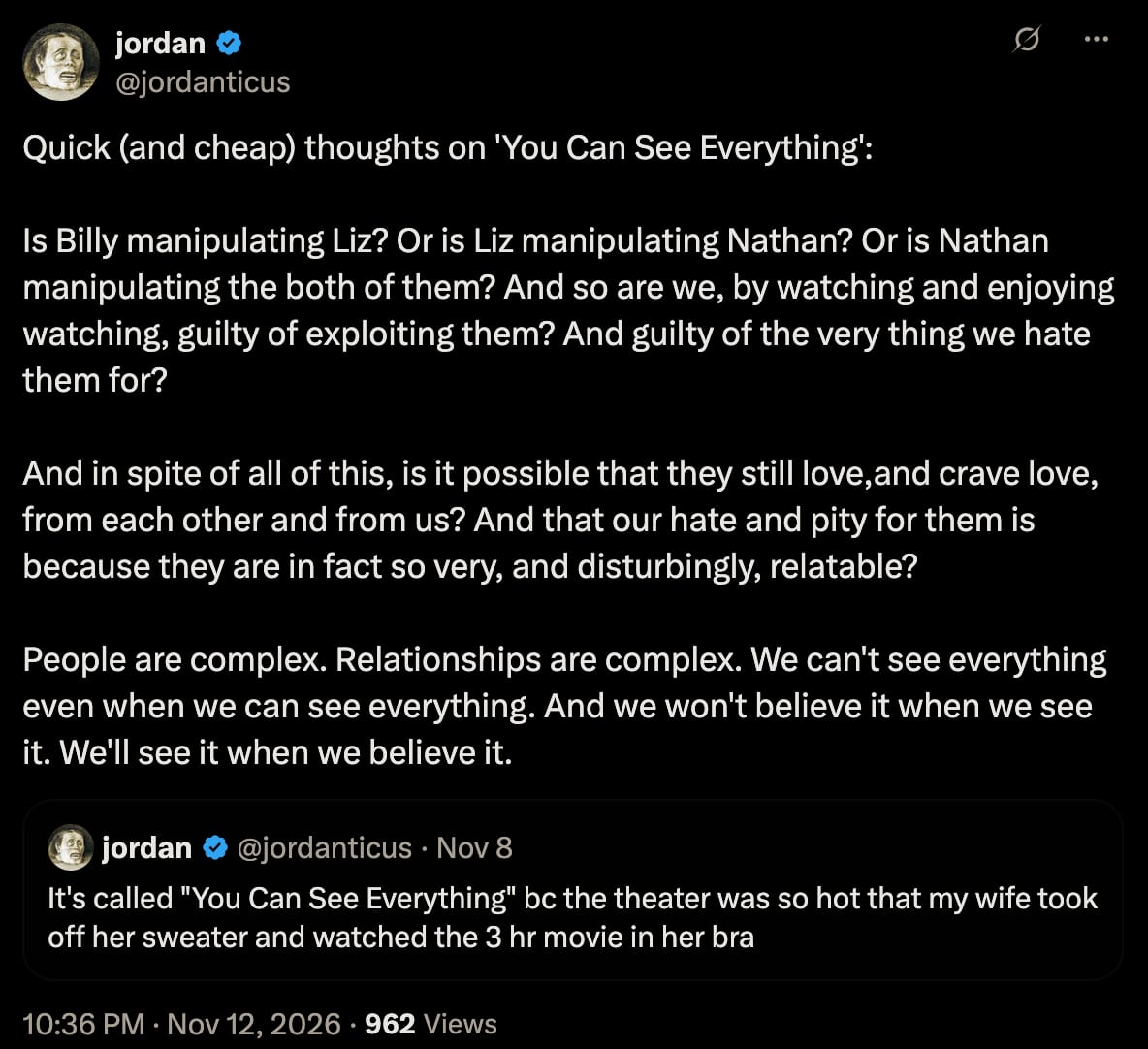
notes
intentionally cliche and yet still nauseating to type ↩︎
"Outliers" (Episode 6): Depicts Holmes overriding warnings about invalid lab data. She says "throw it out" or something to that effect in the show, and Holmes claims to have never said that. ↩︎
I'm not even getting into the whole Enron thing with her dad. He did seem closer to middle management, but who knows!!!! It's a helluva coincidence. ↩︎
asshole, Seyfried said what we were all thinking ↩︎
The whole thing about lasers looking at blood personally gave me the ick, but perhaps it will fizzle out before it blows up. Or maybe she'll get into AI. ↩︎
I support women's rights AND women's wrongs 😤 ↩︎